

On January 20th, Cai Fang, COO of YOYI TECH, was invited to speak at NVIDIA’s APAC AI Marketing Week, delivering a presentation titled “From Content Marketing to AI Visibility: GEO Reshapes Brand Influence”.
Amid the global wave of AI search, the battleground for brand marketing is undergoing a fundamental shift. Traditional search engine optimization (SEO) logic is no longer sufficient to address the challenges posed by generative AI. Brand influence now depends not only on rankings in search results but more crucially on being seen and accurately conveyed in AI-generated answers. This is the core mission of Generative Engine Optimization (GEO): in the AI era, helping brands reclaim narrative sovereignty and become the preferred and trusted information source for AI.
01 AI Reshapes Consumer Decisions, Brand Sovereignty at Risk of Erosion
AI applications in the Chinese market have experienced explosive growth. Native AI apps such as TikTok Doubao, Alibaba Tongyi, and Baidu AI, along with in-app AI features, now reach hundreds of millions of users. Consumers’ decision-making journey has shifted from the traditional “Search-Browse-Compare” to “Ask-Answer-Act”.
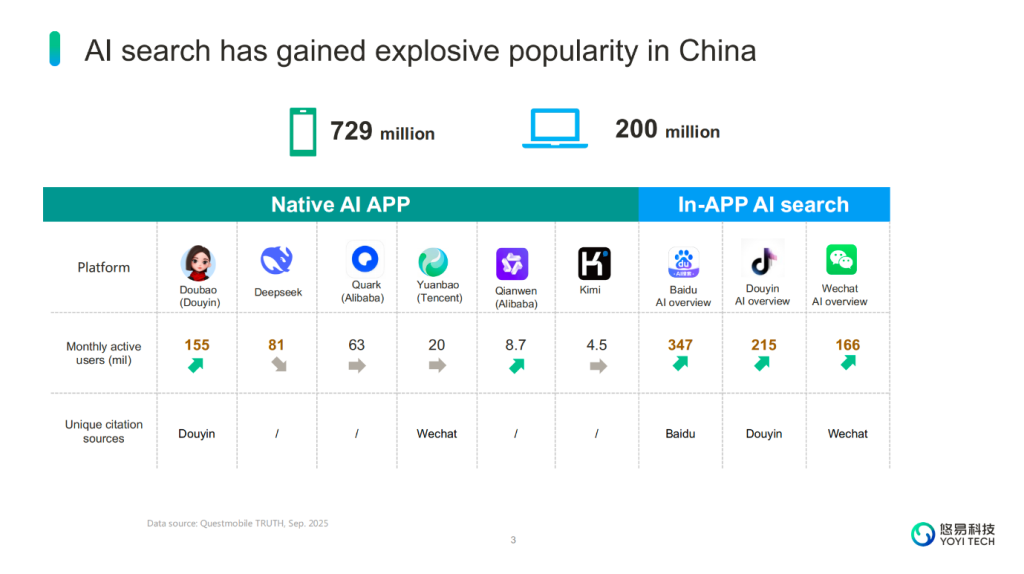

In this process, AI acts as the information gatekeeper, providing only information summaries rather than the traditional list of blue links. This means brands are either mentioned in AI answers or completely “invisible”.
An even more pressing challenge is the erosion of “brand sovereignty”: being overlooked (brand not appearing in AI answers), misinformation (AI conveying incorrect or outdated information), and being replaced (brand’s core intellectual assets used by AI but credited to competitors). There is a significant risk that traditional marketing investments may become ineffective in the AI era—if AI fails to understand your brand, billions in marketing spend could go to waste.
02 GEO: A New Language to Communicate with AI, Not Control It
GEO is not a simple upgrade of SEO. Its essence is building a language system that enables AI to understand accurately. The goal is not to control AI models in the “black box”, but to ensure that when AI retrieves, processes, and disseminates information, it can accurately capture and convey the brand’s true value, product advantages, and technical capabilities through optimized content.
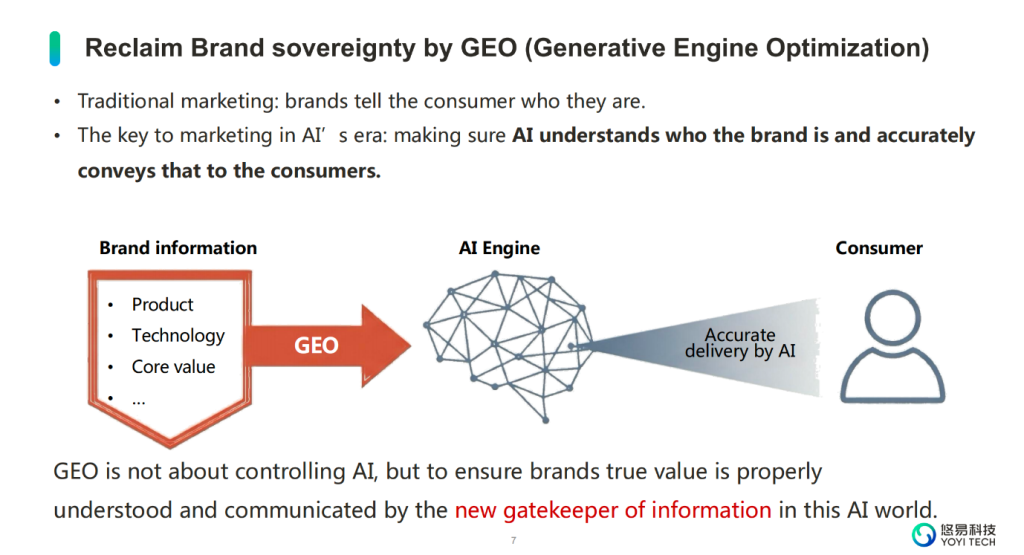

The core metrics for GEO include: Brand Visibility (frequency of brand appearance in AI-generated answers), Information Accuracy (extent to which brand information is conveyed without deviation), and Brand Image (sentiment orientation of brand-related content in AI-generated responses). Together, these metrics form the brand’s “digital identity” in the AI world.
03 Differences in Global Practices: China Focuses on Short Videos and “Brand Co-Creation”
While GEO’s global objectives are consistent, there are significant differences in optimization environments and strategic priorities between China and overseas markets. Overseas, the core of optimization remains brand official websites, blogs, and Wikipedia, aiming to facilitate AI crawlers in accessing authoritative information. In China, however, the priority of brand official websites is relatively low, with short videos and social content becoming the main optimization frontiers.
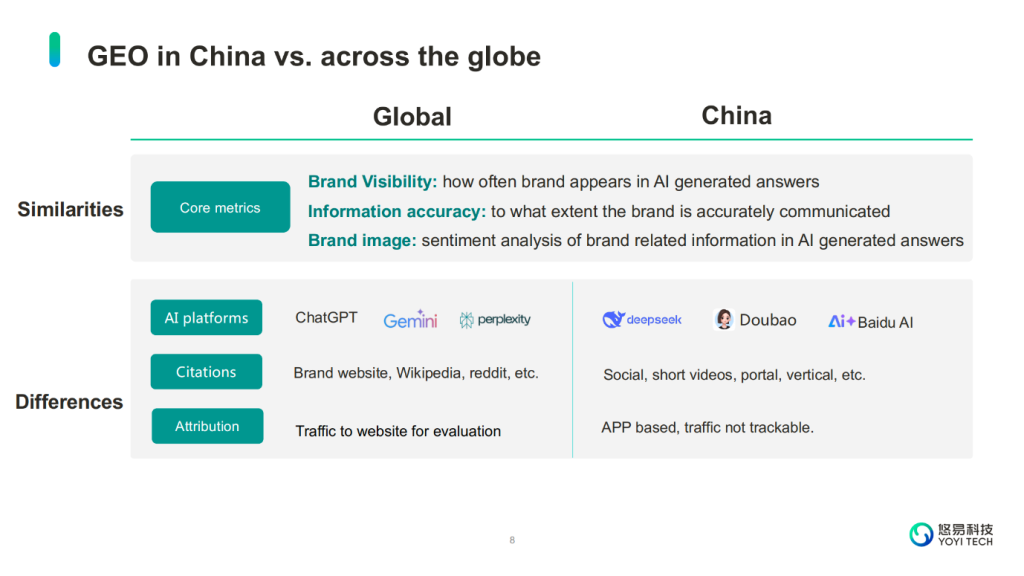

Additionally, the brand co-creation mechanism initiated by People’s Network can directly synchronize structured brand information to major domestic AI models, partially replacing the authoritative information source function of official websites.
As AI platforms such as Doubao and Qwen gradually integrate shopping features, GEO has become a key bridge connecting content marketing and AI instant shopping. China’s AI ecosystem is dominated by major “walled gardens”, resulting in a high degree of fragmentation in shopping links and content sources (e.g., Doubao mainly cites TikTok content, Yuanbao cites WeChat content), which further increases the complexity of unified GEO implementation.
04 Core Strategy: A Dual-Content System for “One Content, Two Uses”
An effective GEO content strategy requires brands to build a dual-content system for “one content, two uses”:
- Human-oriented content: Focuses on emotional resonance and brand storytelling, disseminated through social activities, PR campaigns, etc.
- AI-oriented content: Emphasizes factual statements, strictly adheres to the E-E-A-T (Experience, Expertise, Authoritativeness, Trustworthiness) principle, and adopts a clear Q&A format.
The key to optimization lies in maximizing the overlap between the two types of content to improve efficiency. For example, when creating Tiktok short videos, core keywords should be placed prominently in titles, descriptions, and tags to help AI quickly capture key brand and product information; at the same time, select high-authority media preferred by AI for content distribution.。
05 Key to Implementation: Cross-Departmental Collaboration and Long-Term Platform Construction
The successful implementation of GEO cannot be achieved by a single team; it requires integrating multiple departments including product, marketing, brand, PR, sales, and channels to form an AI-oriented collaborative workflow. From product information refinement and KOL content optimization to e-commerce page and review management, every link needs to incorporate AI-understandable thinking.
In the long run, a professional GEO platform is crucial for brand building. It can provide short-term monitoring and diagnosis of AI answers, and in the long term, construct the brand’s AI marketing knowledge base, continuously consolidating the brand’s authority and credibility in the AI world.
Conclusion
AI search is not the future—it is happening now. GEO marks a new era in brand marketing, shifting from “competing for webpage clicks” to “competing for AI mindshare”. Brands that take the lead in mastering the language to communicate with AI and systematically building their AI visibility will gain a crucial first-mover advantage in the new battleground of reshaping influence, defending brand sovereignty, and even driving direct conversions.